
Digital Imaging & the Preservation of Tangible Cultural Heritage Internatinal Course 2025/2026
This online course introduces students to the use of advanced digital imaging technologies in documenting, preserving, and disseminating tangible cultural heritage. Topics include aerial and satellite imaging, close-range photogrammetry, 3D scanning, and microscopic inspection, with a focus on their applications in the conservation, restoration, and global accessibility of cultural assets.
The course features weekly lectures by international experts, offering students exposure to various technical, theoretical, and applied perspectives. Case studies from field and laboratory settings will illustrate the practical use of these tools in heritage-related contexts.
No prior technical background is required. The course is open to students from all disciplines and will be in English. It fulfills the mandatory English-language course requirement for degree programs.
FIRST LECTURE
27.10.2025 6:00 PM – 8:00 PM (UTC +2)
Prof. Moshe Caine – Digital Heritage Preservation: An Overview
The huge advances that we are witnessing in digitization technologies over the past decades are opening the door to conservation, preservation, restoration and dissemination of our tangible cultural heritage on an unprecedented scale. New documentation methods provide us today with the opportunity not only to experience the beauty and value of these cultural assets, but also to share and distribute them worldwide.
Nowhere is this impact greater than in the vast field of imaging. Digital imaging technologies are exploring and uncovering new frontiers in nearly all areas of heritage research. From covering large regions with space and air to inspecting at a microscopic level. From the world visible to the human eye to the unseen realm beyond our spectral capacity. From secrets embedded within surface textures to hidden worlds lurking beneath the surface.
This opening lecture will provide an overview of the broad topic and briefly touch on the various fields, applications, and technologies, which will be expanded upon in the upcoming talks. The lecture will cover areas such as multispectral imaging, 3D imaging, reflectance transformation imaging, CT, macro, and other fields.
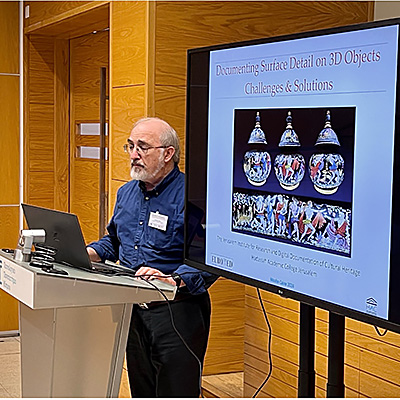
About Moshe Caine

SECOUND LECTURE
03.11.2025 6:00 PM – 8:00 PM (UTC +2)
Sharon Tager – Balancing light – An Introductory Historic Overview of the Role of Imaging in the Conservation of Museum Collections
The conservation profession has changed and shifted over the last 100 years. Its beginnings are characterized by an apprentice-based work model, requiring mostly great manual dexterity, followed by the introduction of science and technology in the aid of the conservator. During the last century, conservators have used science as an aid for rationally based decision-making processes as opposed to decisions based on subjective criteria like taste and budget. Nowadays, the discourse is shifting back to a more critical understanding of the weight given to science in conservation and its ability to promote a holistic approach for treatment. Many museums have also learned to harness science, and particularly digital imaging, in order to engage audiences around the world with cultural heritage. The central role of imaging in conservation is present in all these shifts of practice and thought. The lecture will include an historical overview of the various questions asked by conservators in the museum sphere, while enabling the participants to understand the conservation context of the various imaging techniques. These will include the early uses of X-radiography, UV, visible, NIR and multi-band imaging, RTI and 3D scanning. Examples will include conservation projects from the Conservation Department at the Israel Museum.
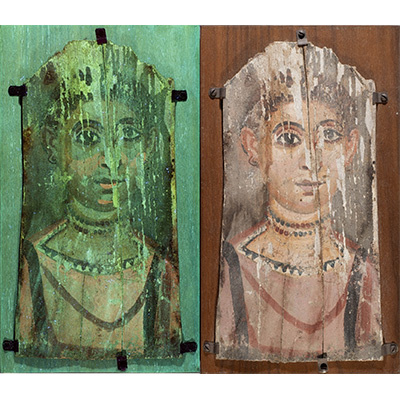
About Sharon Tager
Sharon Tager is Head of Conservation at the Israel Museum, Jerusalem. She obtained her MA in Art History and Theory from Goldsmiths College, University of London in 1997, and graduated as a painting conservator after completing the three- year postgraduate program at The Courtauld Institute, University of London in 2001. Sharon practiced as a conservator in the U.K. and in Israel, working on both national and private collections. Her particular interests lay in conservation emergency preparedness for cultural heritage, the formation of a database for artist interviews for Israeli artists and the challenges of preservation and conservation of contemporary art in the museum sphere.