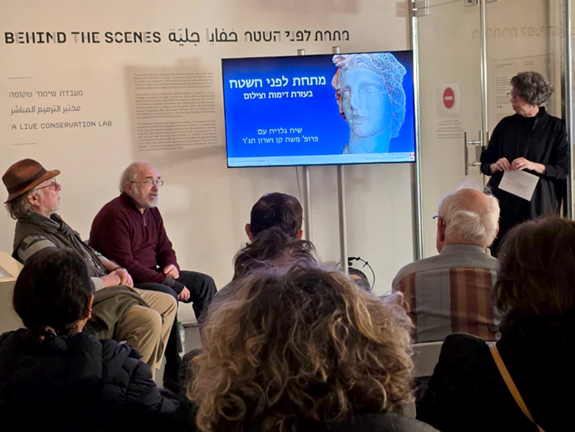
Last month, Prof. Caine and Michael Maggen were invited to participate in the exhibition “Transparent Laboratory,” devoted to the topic of digital imaging technologies as a tool for non-invasive conservation and analysis. The meeting was hosted by Sharon Tager, head of conservation at the Israel Museum. In this exhibition, the work of the conservators—usually carried out far from the visitor’s eye—is revealed to the public for the first time. In the transparent laboratory, the conservators work in front of the audience and expose the conservation processes that typically take place behind the scenes before objects are put on display. At the front of the exhibition, eight objects from the museum’s collections are presented, each with an interesting story uncovered during the joint research of the curators and conservators.
Conservation is intended to ensure the material integrity of cultural heritage objects. To achieve this goal, it adheres to ethical guidelines and remains faithful to the values and principles that guided the creation of the objects. The museum’s conservation department includes six laboratories that care for hundreds of thousands of items in the collection, each specializing in different materials. It is the first and largest department of its kind in the country, with a rich and distinguished history as a leader in the field of conservation.
This project is the result of a collaboration between the Israel Museum and the Ministry of Heritage, which is responsible for developing, strengthening, and empowering national heritage among the public. It is intended to express the shared mission of both institutions to serve as a link in the chain that preserves heritage values and passes them on to future generations.